
Case studies / Peltier thermal simulator
Peltier thermal simulator for thermostatic valve testing
A portable test rig in one case that imitates room temperature changes and measures, continuously and side by side, how thermostatic valve heads respond. All electronics, sensors, mechanics, firmware and software are our own design.
Talk to the founder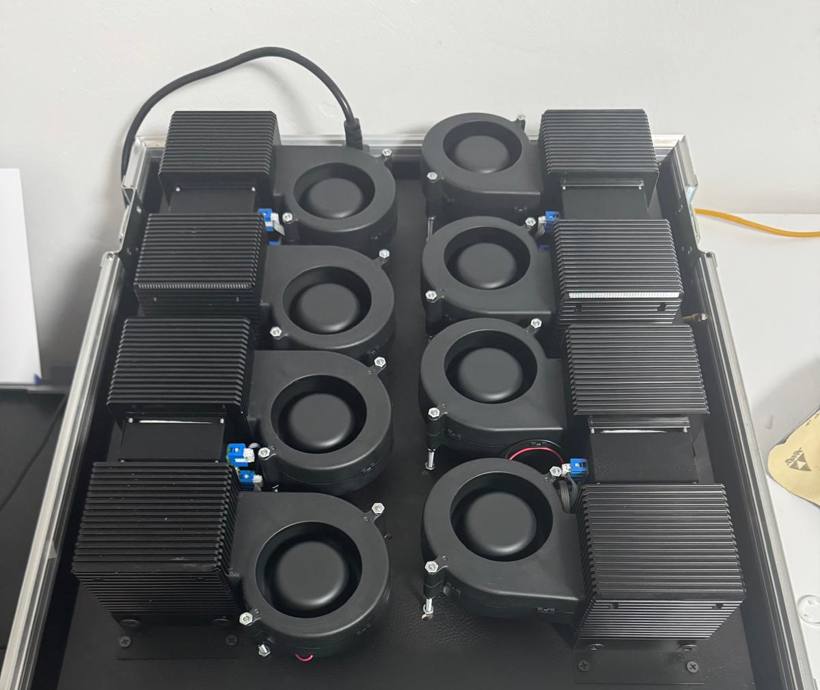
The challenge
A thermostatic radiator valve reacts to the room temperature through a remote sensor, and the speed of that reaction depends on the technology inside the head. To show this to customers, a manufacturer needed a demonstrator that could change the temperature around several valve heads in a repeatable way and show exactly how each actuator moves.
The requirements: simulate room temperature between 10 and 30 °C, measure the actuator stroke of about 4 mm continuously and not only at the end positions, compare gas-filled and liquid-filled heads under identical conditions, and run everything from a normal 230 V single-phase socket.
Our solution
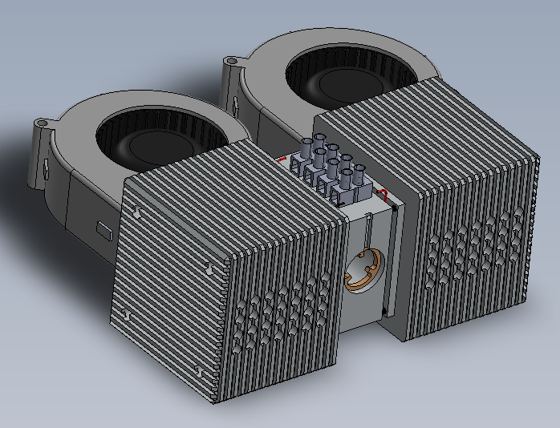
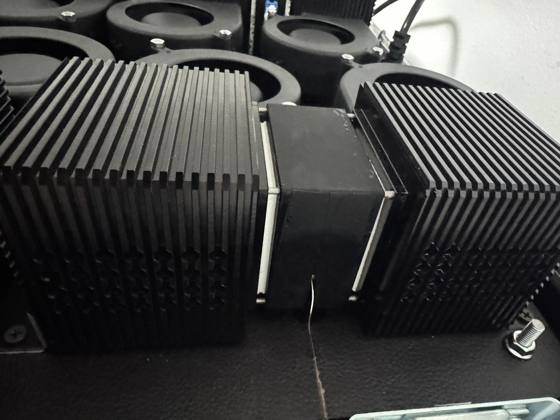
Inside one case we built four independent assemblies, two for gas-filled and two for liquid-filled heads. Each assembly is an aluminium monoblock heat exchanger with a Peltier element on each side, a finned heat sink and a blower. A precise temperature sensor reads the monoblock, and a magnetic position sensor in a custom insert reads the movement of the valve actuator.
One custom control board regulates all four assemblies and streams the data to a PC, where our software shows, logs and controls everything. In our tests the rig went far beyond the specification: it reaches −20 °C quickly, so cold that ice forms on the monoblock, and it heats up to 40 °C.
How the heat exchanger works
A Peltier element moves heat in the direction of the current. Reverse the current and the same element switches between cooling and heating.
A simulation you can trust
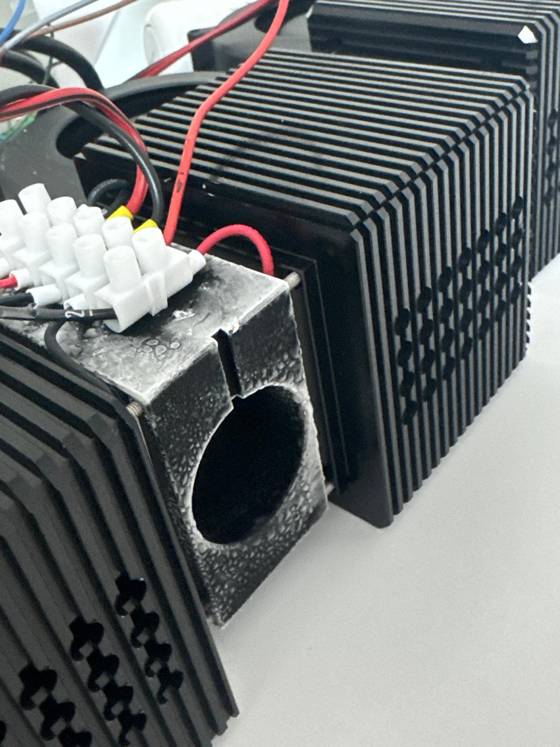
The remote sensor of a valve sits in a cutout of the monoblock, separated by a small air gap. The gap is deliberate. Our first prototype had no gap, and the sensor reacted instantly, which is neither realistic nor fair to the slower technology.
We could have simulated the heat transfer in software, but then anyone could tune the simulation to produce a desired result. We chose a physical solution instead: real heat, a real air gap and regulation directly on the metal. Two sizes of remote sensor exist, so we made two monoblocks with different thermal mass, tuned so that they respond identically under control.
Sensing
A digital band-gap temperature sensor with about 0.1 °C accuracy and very low thermal mass sits directly on the monoblock, on a small PCB we designed for it.
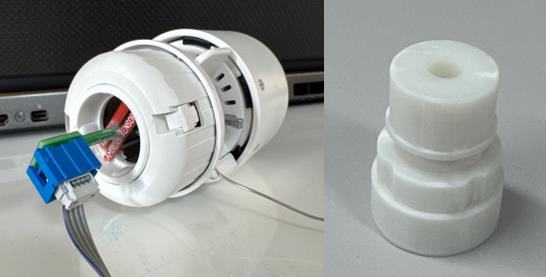
The valve position is measured by a 3D magnetic sensor in an insert that clips into the thermostatic head exactly like the valve does, so the valve itself is never modified. A 10 × 2 mm magnet on the contact point moves with the actuator, and every sensor is calibrated individually, with the calibration stored in the firmware.
Efficient control electronics
The control board has a processing unit, a power stage with eight control channels, a sensor section and a smoothed power supply. Each of the four branches carries a temperature sensor and a position sensor. Because identical sensors share the same address, a built-in communication switch separates the branches and isolates them from each other.
Peltier elements waste energy when they are driven with a simple on-off signal, because the parasitic heat rises with the square of the voltage. So we developed a new generation of the controller that modulates the power at around 100 kHz and filters it, which makes it behave like a true analogue supply.
The result is less wasted heat, less thermal stress and smaller heat sinks. In our bench tests, two Peltier elements at just 14 W each cooled the monoblock from 22.5 °C to 12.5 °C, and at higher power the monoblock dropped by 10 °C in less than two minutes.
The heat sinks matter as much as the Peltier elements. When they cannot get rid of the heat fast enough, it flows back through the element and the cold side warms up again. We solved this with more thermal mass, more surface and strong airflow.
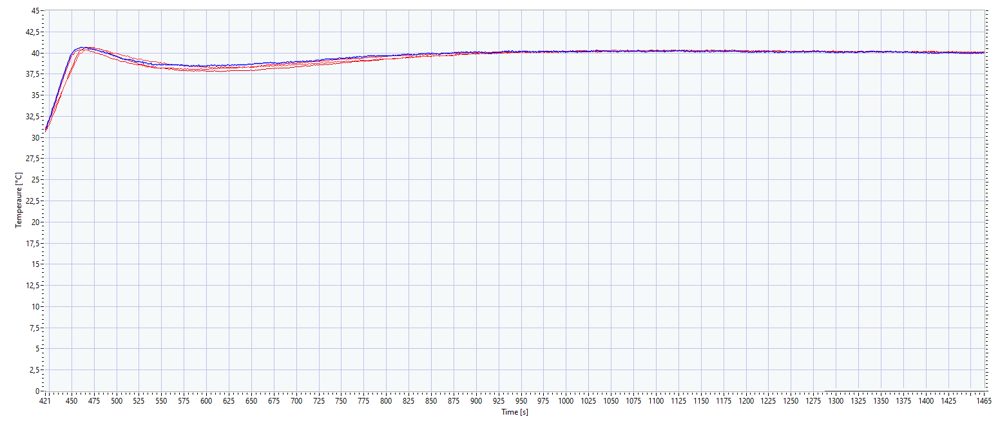
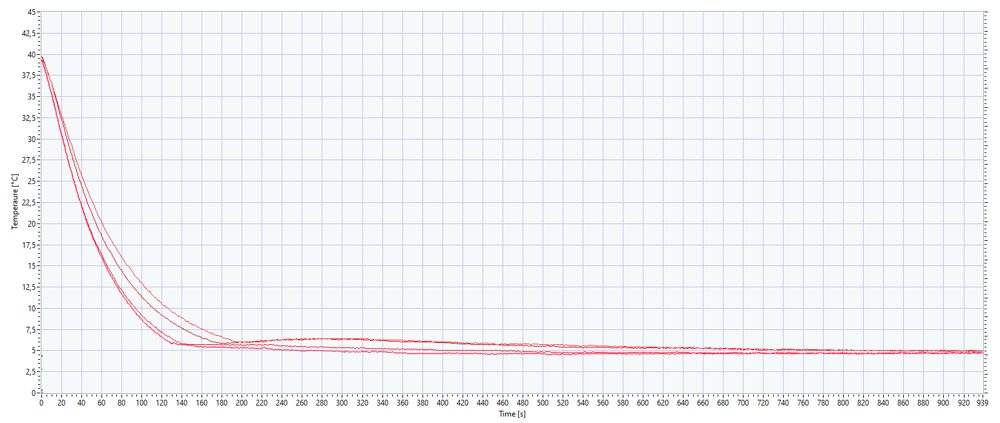
In both charts the temperature curves of the four assemblies lie almost on top of each other. The assemblies are independent, but they follow the same profile.
Software
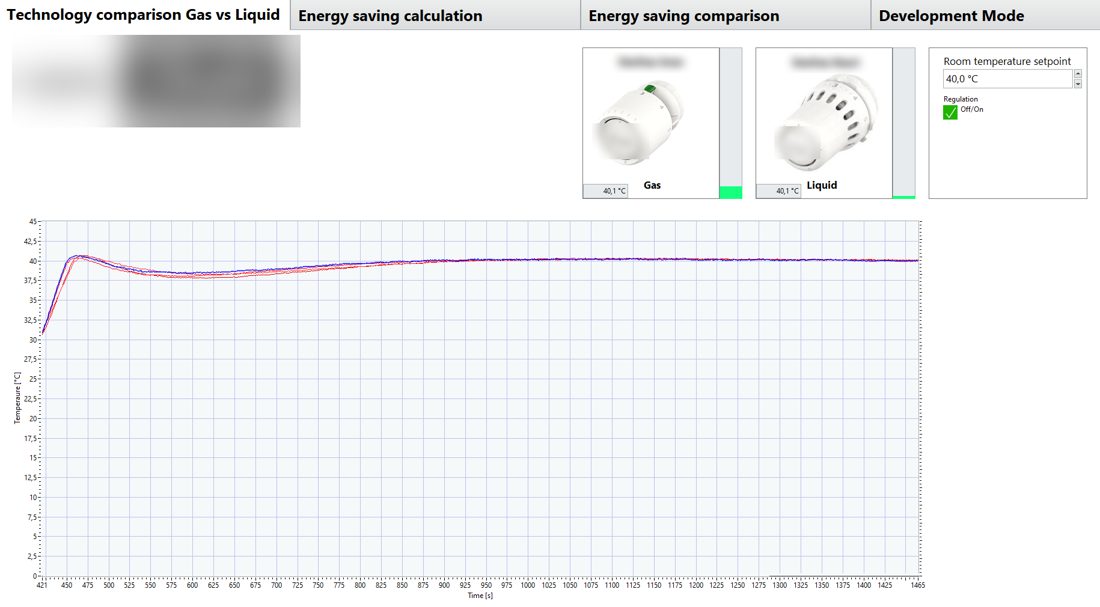
The microcontrollers on the control board run firmware written in C. It cycles through the four sensor branches, initialises them and streams continuous measurements to the PC. The PC interface, built in LabVIEW, shows live temperature and position traces for every assembly, logs the data and sets the temperature profile. It also has dedicated views for technology comparison and for energy saving calculation, and a development mode for service work.
Built step by step
Every part went through several versions, and each one was tested on its own before the full system. The position sensor moved from an optical to a magnetic design, the heat exchanger gained an air gap, active cooling and bigger heat sinks, and the electronics moved from simple switching to analogue-style regulation.
What the customer gets
Side-by-side comparison
Four heads are tested at the same time under identical conditions, so differences come from the technology and not from the test.
Continuous measurement
The full movement of the actuator is recorded, not just its end positions.
Honest results
Physical heat exchange instead of a software model means that the result cannot be tuned to look better.
Portable and simple to power
Everything is in one case that runs from a single-phase 230 V socket.
Efficient design
Analogue-style control of the Peltier elements keeps parasitic heat, power use and heat sink size low.
Fully custom
Electronics, sensors, mechanics, firmware and software were all made by us, so we can adapt the rig to other products.